
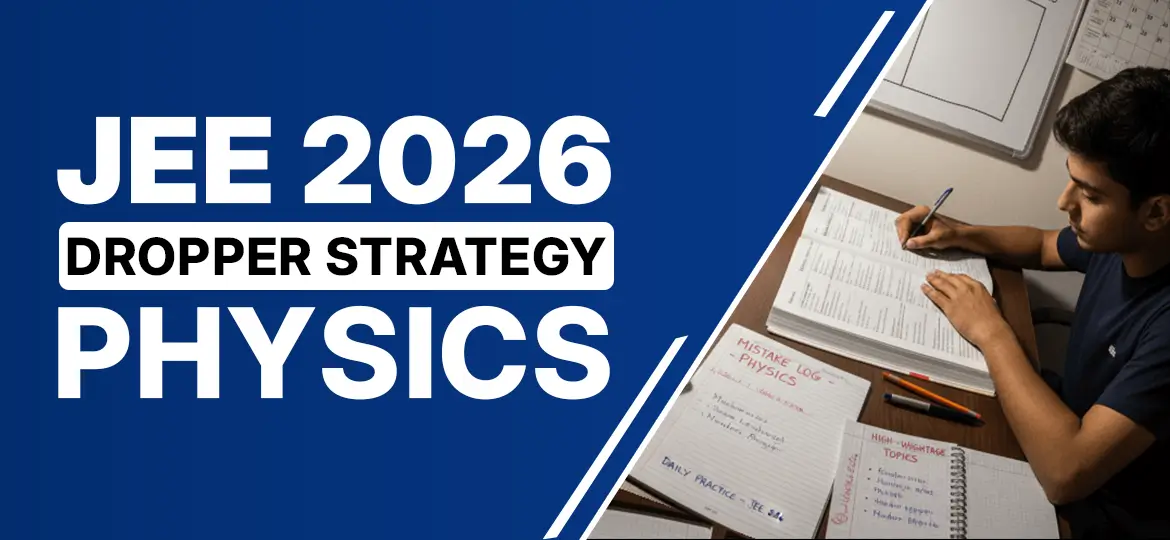
If you are repeating a year for JEE and Physics feels slippery, you are not alone. Many droppers know formulas by heart but still lose marks due to small slips, weak connections across chapters, or simply because of limited exam-style practice. The good news is that Physics can become your scoring subject with the right structure. This JEE Dropper Strategy for Physics – Complete Study Plan is built to give you a simple daily plan, a mistake log that actually works, and a clear map of high-weightage topics so you don’t feel lost.
Know the Paper You Are Training For
Before you even decide how to study, it’s important to know the paper inside out. For JEE Main 2026 Paper 1, you attempt 75 questions worth 300 marks. Out of these, Physics carries 25 questions, which include 20 multiple-choice questions and 5 numerical value type questions. Since negative marking applies in both sections, every guess or careless slip can cost you hard-earned marks. That’s why accuracy matters just as much as speed, if not more. Once you understand this balance, you’ll realise that your goal is not just solving more but solving smarter.
JEE Advanced, on the other hand, changes its pattern every year, but one thing always stays the same: it rewards deep reasoning and the ability to connect multiple concepts in a single problem. If you aim to appear for Advanced as well, don’t let its unpredictability scare you. Instead, solve a few past Advanced papers to build that multi-concept mindset. Even if your main target is JEE Main, practicing some Advanced-level problems sharpens your fundamentals and trains you to think beyond formulas, which eventually makes the Main paper feel more comfortable.
High-weightage Physics for JEE Main
Weightage fluctuates, but past-year analysis shows a clear pattern. Use the table to priorities when time is tight. Numbers are typical distributions from recent sessions.
JEE Main Physics Topics That Frequently Carry Higher Weight
| Chapter or Unit | Typical questions | Approx weight |
| Modern Physics | 4 to 5 | 15 to 20 percent |
| Current Electricity + Electrostatics | 4 to 6 combined | 15 to 20 percent |
| Optics (Ray + Wave) | 3 to 4 | 10 to 13 percent |
| Heat and Thermodynamics | 2 to 3 | 8 to 12 percent |
| Magnetic Effects, EMI, AC | 3 to 4 | 10 to 13 percent |
These ranges come from PYQ breakdowns by mainstream prep portals. Several analyses place Modern Physics around 15 to 16 per cent, Optics near 10 per cent, and Thermodynamics close to 10 per cent. Use them as planning signals.
Daily Practice Blueprint for Droppers
Aim for 5 to 6 focused hours on heavy days and 3 on light days.
- Concept warm-up, 30 minutes
Pick a micro-topic. Read notes or a trusted summary, then write a one-page “what, why, when” sheet. - Targeted problems, 75 to 90 minutes
Solve 25 to 35 questions from one micro-topic. Tag each with K for knowledge gap, P for process mistake, and A for attention slip. - Mixed set, 45 minutes
Fuse ideas from two areas, like EMI with AC phasors or ray optics with small-angle approximations. - Speed round, 20 minutes
Choose 10 quick hitters and race the clock, then spend 5 minutes checking units and significant figures. - Past paper mini mock, 45 to 60 minutes
Attempt any single-shift Physics section from a recent JEE Main. Enter errors in your log at once.
The Mistake Log That Actually Works
A mistake log only works if it is quick to fill and easy to revisit. Keep it lean, searchable, and alive.
Minimal Mistake Log Template
| Date | Source | Topic | Type of error | Root cause in one line | Fix or cue | Revisit date |
| 2025-08-24 | PYQ Jan shift 2 | Ray optics, lens maker | Calculation sign | Missed minus for virtual image | Draw real-virtual ray sketch first | 2025-08-31 |
| 2025-08-25 | Mock 06 | Kinematics graph | Reading error | Read m as minutes, not meters | Highlight units before solving | 2025-09-03 |
How to Use It?
• Tag every wrong or lucky correct as K, P, or A.
• Write the fix as a cue, like “draw energy bar first.”
• Schedule a revisit. On that day, redo only the marked questions, then add one fresh problem of the same type.
A One-Week Plan That Balances Scoring and Depth
Here is a dropper plan Physics JEE weekly cycle to plug in immediately. Swap topics based on your weak links, but always keep one high-weightage unit in play.
- Day 1 Modern Physics basics, nuclear and radioactivity. Evening: 30 to 35 problems and a short formula sprint.
- Day 2 Current Electricity networks and meter problems. Evening: 25 problems then 10 PYQ in timed mode.
- Day 3 Optics from mirrors to lens maker. Evening: Mixed set of Optics plus Kinematics graphs.
- Day 4 Thermodynamics first law and PV curves. Evening: Heat transfer shortcuts and approximations.
- Day 5 Magnetism and EMI starter pack. Evening: AC phasors, power factor, resonance.
- Day 6 Full Physics section test in 60 minutes, review and log. Formula sprint covering the week’s units.
- Day 7 Light day. Revisit mistake log items and do 20 PYQ from a different year. Short Advanced-style set for the top two topics.
Physics Revision Tips JEE That Save Time
- Two-layer revision
Layer 1 is your one-page micro-notes per topic. Layer 2 is a formula ladder of 200 to 250 lines that you can scan in 20 minutes. - Spaced revisit rhythm
Use 1-3-7-14 spacing. Visit a topic 1 day after study, then on day 3, day 7, and day 14. - PYQ-centric drilling
For every chapter, do PYQ by subtopic in blocks of 20. When accuracy reaches 80 per cent, switch to mixed blocks across chapters. - Formula proof checks
Re-derive two key formulas per chapter from first principles. - Unit and dimension filter
Before marking an answer, perform a five second sanity check on units and sign.
Resource Order That Works
Start with Mechanics basics, then Current Electricity and Electrostatics, Optics and Modern Physics, Heat and Thermodynamics, then Magnetism, EMI, and AC, with SHM and Waves threaded through. If Modern Physics or Current Electricity is already strong, start there and bank quick marks.
NCERT, How Much to Use
NCERT will not alone take you to a 95 plus, yet it is essential for basics, standard values, electromagnetic waves, optics conventions, and fact checks. Read it fast at the start of a chapter, keep a short checklist of likely direct facts, and pair it with a problem-heavy source and PYQ.
Explore more tips, strategies, and success stories on our official YouTube channel: Matrix JEE.
Stay updated with the latest guidance for IIT aspirants and learn how Matrix JEE helps students achieve their dream of cracking JEE with expert mentorship.
Conclusion
A good drop year is not about doing everything. It is about doing the right things repeatedly. Anchor your day with a short concept pass, an honest problem block, and a living mistake log. Keep one high-weightage unit in rotation every week, keep testing regular, and keep revisions short and spaced. Stay consistent. This is exactly how the JEE Dropper Strategy for Physics – Complete Study Plan helps you build stable scoring and avoid unnecessary mistakes in JEE Main 2026.
FAQs
A dropper should follow a daily mix of concept revision + topic-wise practice + PYQs. Start with one micro-topic daily, solve 25–35 questions, and attempt Physics section mocks regularly. Maintain a mistake log and revise it weekly to avoid repeating the same errors.
The most scoring and high-weightage chapters usually include Modern Physics, Current Electricity, Electrostatics, Optics, Thermodynamics, EMI, and AC. These topics appear frequently in PYQs and can help you secure strong marks with smart revision.
For a dropper, solving 30–50 Physics questions daily is ideal (topic-wise + mixed). Along with this, 10–15 PYQs in timed mode build exam speed and accuracy, which is the biggest difference-maker in JEE Main.
To reduce silly mistakes, always do unit/sign checks, underline keywords in questions, and keep rough work clean. Most importantly, maintain a mistake log and revise it every week. Regular timed practice automatically reduces panic-based errors.
NCERT is important for basics, definitions, and some theory-based areas, but it is not enough alone. For a strong score, use NCERT + a problem-solving source + PYQs and mock tests to improve real exam-level execution.
Learn More:-
- JEE 2026 Maths Dropper Strategy: Toppers’ Weekly Preparation, Chapter Priorities, Time Table
- Government Medical Colleges in Uttar Pradesh 2025: List, MBBS Seats, Course Fees and Facilities
- Government Medical Colleges in Maharashtra 2025: Full List, Facilities & Fees Comparison
- Daily Routine of a JEE Topper: Perfect Timetable for IIT Success
- JEE Advanced 2026 Exam Date Out
