
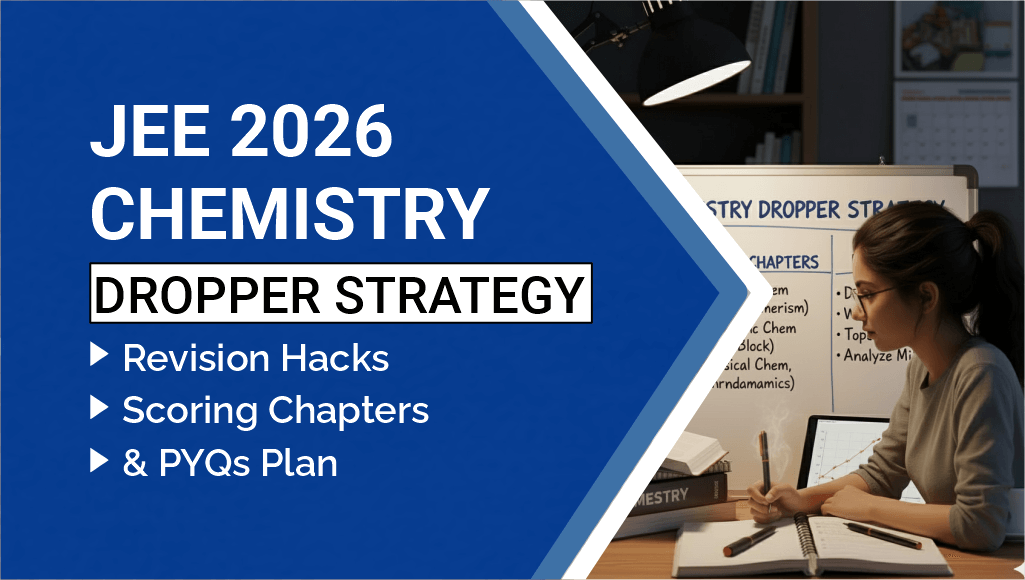
If you are dropping a year for JEE 2026, Chemistry can become your strongest scoring subject. Unlike Physics and Maths, which demand heavy problem-solving, Chemistry rewards consistency, sharp recall, and familiarity with exam trends. The goal for a dropper is not to start everything from zero but to build a revision system that converts old learning into quick recall and mistake-free accuracy during the exam.
This JEE 2026 Chemistry Dropper Strategy guide gives you a clear roadmap: how to prioritise chapters, smart revision hacks, an effective plan for solving past-year questions (PYQs), and a simple table of high-weight topics.
Why Chemistry Can Be Your Advantage?
In JEE, Chemistry is often seen as the “rank booster” subject. Many toppers use Chemistry to secure steady marks because it includes a mix of memory-based, conceptual, and problem-solving questions. In JEE Main, Chemistry questions are usually more straightforward and can be solved faster, giving you more time for Physics and Maths. In JEE Advanced, the subject requires deeper application but still offers many scoring opportunities if you prepare systematically.
First Reality Check: What Chemistry for JEE Actually Covers
A dropper needs to treat Chemistry as three different subjects:
- Physical Chemistry: Concept-based numericals, formulas, and problem-solving.
- Organic Chemistry: Reaction mechanisms, named reactions, and pattern recognition.
- Inorganic Chemistry: NCERT-based facts, exceptions, and periodic trends.
Since each part has a different preparation style, your revision approach must also vary for each section.
Scoring Chapters You Must Not Miss
Coaching analyses and PYQ breakdowns from multiple years repeatedly show some chapters appear more often and yield “safe” marks. Use the table below as a priority map. Numbers are approximate ranges based on aggregated PYQ studies and should be used to prioritise study, not to replace complete syllabus coverage.
| Chapter / Topic | Section | Approx. PYQ weight (past-year aggregate) | What to aim for in revision |
| Coordination compounds | Inorganic | High (one of top-scoring topics) | Master nomenclature, isomerism, bonding, complexes calculations |
| d- and f-block elements | Inorganic | High | Focus oxidation states, electronic configuration, trends |
| Thermodynamics & Gaseous State | Physical | High | Understand laws, typical numericals, standard states |
| Chemical Equilibrium (incl. ionic) | Physical | Medium-High | Practice Kp, Kc conversions, buffer and pH basics |
| Solutions & Colligative properties | Physical | Medium-High | Clear formula sheet and typical problems |
| Chemical Kinetics | Physical | Medium | Rate laws, integrated rate equations, half-life |
| Aldehydes, Ketones, Carboxylic acids | Organic | Medium-High | Reaction mechanisms, identifying reagents and synthetic steps |
| Organic basics (GOC, Hydrocarbons) | Organic | Medium | Reaction types, resonance, stereochemistry basics |
| Atomic structure & Chemical bonding | Physical/Inorganic | Medium | Clear concept of orbitals, hybridization, MO basics |
Use these chapters to prioritise the “first pass” of revision and to shape your PYQ practice. If you have less time, shift your effort to the high-weight chapters mentioned above.
Smart Revision Hacks for Chemistry Droppers
- Divide your day into three slots
- Morning: Physical Chemistry numericals (best solved when your mind is fresh).
- Afternoon: Inorganic (short memory drills and NCERT revision).
- Evening: Organic (reaction maps and mechanism flowcharts).
- Morning: Physical Chemistry numericals (best solved when your mind is fresh).
- Make one-page summary sheets
Use these chapters to prioritise the “first pass” of revision and to shape your PYQ practice. If you have less time, shift your effort to the high-weight chapters mentioned above. - Use spaced repetition for Inorganic
Revise inorganic notes on Day 1, Day 3, Day 7, and Day 14, then weekly. This keeps facts fresh without overloading. - Simulate exam pressure
Instead of long theory sessions, solve short timed sets of 5–10 questions. This prevents overconfidence and builds exam temperament. - Maintain an “exceptions diary”
Write down all exceptions you encounter in Inorganic and Organic. Revising these regularly reduces silly mistakes, which are common in Chemistry. - Patch weak chapters in one-week cycles
- Day 1: Read concepts
- Day 2–3: Solve examples
- Day 4–5: PYQs
- Day 6: Timed test
- Day 7: Summary notes
- Day 1: Read concepts
The Chemistry PYQ Plan – How to Use Past Papers to Gain Marks
Past-year questions are the single best guide to question style and recurring concepts. Make PYQs central to your plan rather than an afterthought. Sources like coaching portals and archives provide shift-wise PYQs and solutions — download and organise them by topic.
Concrete PYQ schedule for the last 12 weeks before the exam:
- Weeks 12–9: Topic-wise PYQ drilling. Pick one chapter a day and solve all PYQs from past 10 years for that chapter. Mark patterns.
- Weeks 8–5: Mixed timed sets. Create 60-minute mixed chemistry sets from PYQs covering all three sections once every three days. Review mistakes the next day.
- Weeks 4–1: Full mock chemistry sections under timed conditions (assemble 25–30 chemistry questions simulating JEE format). Use these to simulate pressure and sharpen time allocation. Aim to convert every mock into a short 30-minute “what failed and why” diary.
Where to get PYQs: NTA and major coaching portals and archives provide subject-wise PDFs and solutions. Download shift-wise papers and build a local folder arranged by year and chapter.
Weekly Routine Example for a Dropper (Sample Week)
Here’s a sample routine you can adapt:
- Monday: Physical Chemistry numericals + Inorganic flashcards
- Tuesday: Organic reaction mechanisms + PYQs from one topic
- Wednesday: Full Chemistry mixed set (30 questions) + error analysis
- Thursday: Revise two summary sheets + Inorganic memory drill
- Friday: PYQs from Physical Chemistry + quick Inorganic revision
- Saturday: Full-length mock test (all subjects) with focus on Chemistry mistakes
- Sunday: Light revision day, go over cheat maps and exceptions diary
Avoiding Silly Mistakes – The Smallest Margins Often Decide Ranks
- Underline assumptions: When you solve a numerical, write the assumption you make (ideal gas, dilute solution etc.). A quick assumption check cuts careless errors.
- Sign and unit checks: For physical chemistry answers always do a unit sanity check. If unit mismatches, stop and rework.
- Answer elimination practice: Practice multiple-choice elimination on PYQs. Often eliminating two wrong options gives you the confidence to avoid guesswork.
- Time buffer in exam: Aim to finish chemistry with at least 5-7 minutes extra to re-scan calculations and inorganic facts. Tests show a short scan of answers reduces silly mistakes significantly.
Conclusion
Dropping a year is a test of self-confidence, systems, and knowledge. If you establish strict revision loops, concentrate on high-yield chapters, and make PYQs a daily routine, chemistry can become your most reliable scoring subject. Create a straightforward, repeatable routine, maintain a weekly correction schedule, and approach every mock as a learning experiment. The mentioned chapters and strategies work best when used consistently, as reflected in PYQ analysis and coaching trends.
This is exactly why a structured JEE 2026 Chemistry Dropper Strategy: Revision Hacks, Scoring Chapters & PYQs Plan can significantly boost your Chemistry score.
FAQs
You can recover your JEE Main 2026 application number by visiting jeemain.nta.ac.in, opening the candidate login page, and clicking on “Forgot Application Number”. Then enter your registered details like name, DOB, and parents’ names to retrieve it via email/SMS.
To recover the application number, NTA usually asks for:
Candidate Name
Date of Birth
Father’s Name
Mother’s Name
State of Eligibility
Make sure you enter the details exactly as filled in the registration form.
First, check:
Spam/Junk folder in email
SMS inbox (including promotions/blocked messages)
Network issue / delay
If still not received, try the recovery process again after some time. If it continues, contact NTA support using the helpline/email mentioned on the official website.
No, you cannot download the admit card without logging in. You must have your JEE Main 2026 application number (and password). If forgotten, recover it first using the NTA “Forgot Application Number” option.
Don’t panic. First recover the application number through “Forgot Application Number”. After that, use “Forgot Password” to reset your password via OTP or email reset link. Then you can log in normally.
Learn More:-
- How Many Marks Are Required To Score 90 Percentile In JEE Main
- How Many Attempts for JEE Mains 2025
- JEE Main Eligibility Criteria 2025
- Financial Aid and Scholarships for JEE Aspirants
- JEE/NEET Preparation 2025 : Online vs Offline Coaching – Best Way to Choose
- Top NIT Colleges In India 2025
- JEE Main Marks vs Rank 2025
