
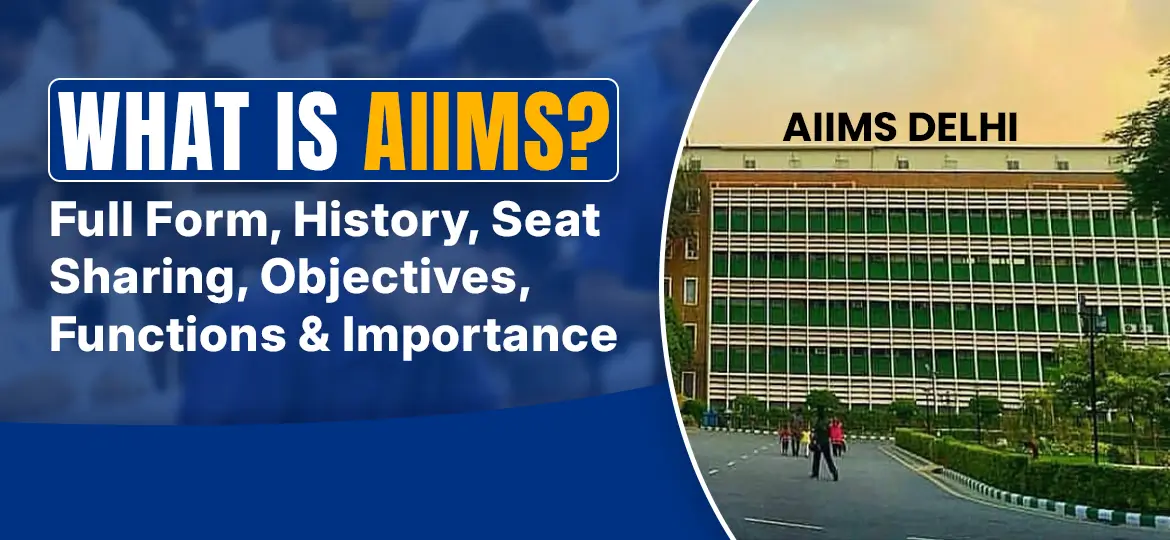
Every medical aspirant should know “What is AIIMS?” MBBS education is a vast area in India, with numerous government and private medical institutes; however, the value of the AIIMS institute stands above the rest. The AIIMS Institute in India is globally renowned for producing the finest doctors with advanced clinical research and exposure to various healthcare services.
In India, thousands of medical aspirants appear in the NEET exam with the dream of pursuing MBBS from their desired AIIMS (All India Institute of Medical Sciences) institute. From its historic beginnings to its nationwide expansion, AIIMS has transformed India’s medical ecosystem. NEET aspirants are also curious about the information related to AIIMS institutes, so this blog will offer you informative insights regarding AIIMS, their importance, objective, functions, and seat matrix to prepare for the upcoming 2026 exam effectively.
What is AIIMS?
All India Institute of Medical Sciences (AIIMS) is an independent, autonomous government medical institute that offers world-class medical education, advanced healthcare services, and cutting-edge medical research. AIIMS is authorised under the AIIMS Act, 1956, which governs AIIMS as an independent body.
The first AIIMS institute was founded in 1956 in Delhi under the vision of Health Minister Rajkumari Amrit Kaur. Currently, 20 AIIMS institutes are fully operational across India, and the government is working to introduce 5-6 new AIIMS institutes very soon. AIIMS holds the title of an institution of national importance to deliver advanced patient care, medical education (UG/PG), tertiary healthcare, and research facilities. The foundational objective of AIIMS is to create an institution that would set global benchmarks in medical education and reduce dependence on foreign medical training.
Full Form of AIIMS
The full form of AIIMS is All India Institute of Medical Sciences. AIIMS medical institutes are globally famous for extensive clinical exposure, research facilities, affordable fees, patient care, medical education, and innovation.
In academics, the AIIMS offers admissions to doctoral, undergraduate, and postgraduate medical courses, where the MBBS UG is one of their most highly demanded courses. Previously, the All India Institute of Medical Sciences, a.k.a AIIMS, conducted its own MBBS entrance exam, but from 2020, all the admissions for MBBS seats are conducted through the NEET (National Eligibility cum Entrance Test) exam.
List of AIIMS in India with MBBS Seats for 2026
The AIIMS (All India Institute of Medical Sciences) Delhi (founded in 1956) is the single and oldest institute established till 2012. After 2012, the government announced the establishment of new AIIMS institutes under 3 phases. Currently, 20 AIIMS in India are fully operational, and 5-6 are expected to start within a few years. The fully working 20 AIIMS medical institutes collectively offer more than 2200 seats for MBBS, where all of these institutes are strategically located to ensure equitable access to advanced healthcare and medical education across the country.
AIIMS Delhi is the base tree of the AIIMS foundational tree, where the government is rapidly developing AIIMS infrastructure, clinical exposure services, and faculty expertise. A detailed analysis of AIIMS institutes with their respective seats is as follows-
| AIIMS Institute Name and Foundation Year | Location of AIIMS | Rating | NIRF Ranking (year 2025) | NIRF Score (year 2025) | Specialisation Factors (Strength) | MBBS Seats | Expected NEET Cutoff Marks |
|---|---|---|---|---|---|---|---|
| AIIMS Delhi, 1956 | New Delhi, Delhi | ⭐⭐⭐⭐⭐ | 1 | 91.80 | Research & Super-speciality, Cardio-Thoracic Sciences, Ophthalmic Sciences, Oncology, Urology, Organ Transplant, Mother Care | 132 | 700+ |
| AIIMS Bhopal, 2012 | Bhopal, Madhya Pradesh | ⭐⭐⭐⭐ | 25 | 60.15 | Clinical Sciences | 125 | 680+ |
| AIIMS Jodhpur, 2012 | Jodhpur, Rajasthan | ⭐⭐⭐⭐ | 19 | 63.18 | Trauma & Surgery, Futuristic medical approaches | 125 | 675+ |
| AIIMS Bhubaneswar, 2012 | Bhubaneswar, Odisha | ⭐⭐⭐⭐ | 14 | 64.31 | Public Health | 125 | 670+ |
| AIIMS Rishikesh, 2012 | Rishikesh, Uttarakhand | ⭐⭐⭐⭐ | 13 | 65.02 | Neurosciences | 125 | 670+ |
| AIIMS Patna, 2012 | Patna, Bihar | ⭐⭐⭐⭐ | 27 | 59.24 | Medicine, Surgery, Diagnostic, Nuclear medicine, Paediatrics | 125 | 680-700 |
| AIIMS Raipur, 2012 | Raipur, Chhattisgarh | ⭐⭐⭐⭐ | 31 | 58.44 | Cardiology, Neurology, Oncology, Gastroenterology, Endocrinology | 125 | 680+ |
| AIIMS Raebareli, 2013 | Raebareli, Uttar Pradesh | ⭐⭐⭐⭐ | NA | NA | Cardiology, Neurology, CTVS, Gynaecology | 100 | 670+ |
| AIIMS Guntur (Mangalagiri), 2018 | Guntur, Andhra Pradesh | ⭐⭐⭐⭐ | NA | NA | Day care, Tertiary care, Cancer treatment, OPD, IPD | 125 | 600-660 |
| AIIMS Nagpur, 2018 | Nagpur, Maharashtra | ⭐⭐⭐⭐ | NA | NA | Cardiology, CTVS, Gastrointestinal Surgery, Anaesthesiology | 125 | 680-710 |
| AIIMS Gorakhpur, 2019 | Gorakhpur, Uttar Pradesh | ⭐⭐⭐⭐ | NA | NA | Cardiology, Neurology, General Medicine, Surgery, Paediatrics, Dermatology, ENT, Psychiatry | 125 | 690-700 |
| AIIMS Kalyani, 2019 | Kalyani, West Bengal | ⭐⭐⭐⭐ | NA | NA | Gynaecology, Ophthalmology, Orthopaedics, Radiodiagnosis | 125 | 680+ |
| AIIMS Bathinda, 2019 | Bathinda, Punjab | ⭐⭐⭐⭐ | NA | NA | Dermatology, Biochemistry, Anatomy, Surgery, Burns & Plastic Surgery | 100 | 630-650 |
| AIIMS Deoghar, 2019 | Deoghar, Jharkhand | ⭐⭐⭐⭐ | NA | NA | OBG, Pathology, Radiology, ENT, Dermatology, Anaesthesiology, Orthopedics | 125 | 620-660 |
| AIIMS Bibinagar, 2019 | Bibinagar, Hyderabad | ⭐⭐⭐⭐ | NA | NA | Surgery, Radiology, Anatomy, Paediatrics | 100 | 650+ |
| AIIMS Rajkot, 2020 | Rajkot, Gujarat | ⭐⭐⭐⭐ | NA | NA | OBG, Pathology, Radiology, ENT, Dermatology, Anaesthesiology, Orthopaedics | 50 | 685+ |
| AIIMS Bilaspur, 2020 | Bilaspur, Himachal Pradesh | ⭐⭐⭐ | NA | NA | Community & Family Medicine, Oncology, Cardiothoracic Surgery, Burns & Plastic Surgery | 50 | 620-680 |
| AIIMS, Guwahati, 2020 | Guwahati, Assam | ⭐⭐⭐ | NA | NA | Gynaecology, Dermatology, Psychiatry, Neurology, Cardiology, | 50 | 650-680 |
| AIIMS Jammu (Vijaypur), 2020 | Vijaypur, Jammu & Kashmir | ⭐⭐⭐ | NA | NA | Cardiology, Neurology, Nephrology, Oncology, Paediatrics | 62 | 650+ |
| AIIMS Madurai, 2021 | Madurai, Tamil Nadu | ⭐⭐⭐ | NA | NA | Medicine, Surgery, Paediatrics, OB-GYN | 50 | 650-680 |
AIIMS Seat Sharing Structure for MBBS
The seat-sharing structure of MBBS is a clear breakdown of the total seats available as per the reservation policy. This seat-sharing mechanism is developed to ensure a fair and transparent distribution of the vacant seats as per the reservation policy of the government. A detailed reservation-based seat-sharing structure of the AIIMS institute is as follows-
| Reservation Category | Percentage of Reservation |
|---|---|
| General Category | 35.5% (Open for all categories) |
| OBC | 27% |
| SC | 15% |
| ST | 7.5% |
| General- EWS | 10% |
| Person with Disability (PwD) | 5% |
Importance of AIIMS Institutes
In the initial days, the actual condition of the Indian medical system was poor, where the government needed a centralised, independent institute to improve three core areas related to medicine, such as healthcare, education, and research, to improve the national healthcare system of the country. A detailed analysis of AIIMS importance in relation to the above 3 factors is as follows-
1. Importance of AIIMS for Medical Education
The AIIMS is a major institute in the field of medical education in India, where its extensive curriculum is research-oriented, clinically intensive, and continuously updated to meet global standards. The academic exposure at AIIMS for MBBS students is developed with advanced technological support, expert faculty, advanced clinical exposure, holistic learning, research focus, and world-class facilities on an affordable fee structure in comparison with other institutes.
The faculty members at AIIMS are leading doctors and researchers, which makes this institute an ideal choice for the NEET aspirants who want to become successful doctors in the future. The highly integrated medical research opportunities at AIIMS provide a platform to the MBBS students to actively participate in cutting-edge medical research to learn advanced level of exposure.
2. Importance of AIIMS for Healthcare Services
AIIMS institutes are established as tertiary referral hospitals and work as highly specialised medical centres that offer high-quality care for complex or severe medical conditions. AIIMS institutes are specially considered for offering expertise in critical medical departments like cardiology, oncology, organ transplants, neurology, trauma, paediatrics, and rare diseases.
Across India, crucial and critical medical cases were shifted to AIIMS hospitals, especially for people who are economically weak. AIIMS institute treats patients with a patient-centric approach, affordable services, and advanced facilities by offering multispecialty care to its patients.
3. Importance of AIIMS for Medical Research
AIIMS medical institutes are the centre hub of innovation and advancement in the field of medical research. Numerous AIIMS institutes successfully conduct various clinical trials for public health studies to find innovative solutions in the field of evidence-based medicine. Every year, approximately 600+ vast research outputs are produced by AIIMS institutes to improve the national health policy.
The medical factors researched and studied by AIIMS have successfully influenced national health programs, disease management protocols, and medical policies. The advanced-level research and innovation exposure also offers benefits to the MBBS students by offering training for research methodologies in the early stage with a scientific mindset. AIIMS also collaborates with international institutions, where its recent research partners are University College London, Harvard University, the University of Washington, and so on.
Objective and Functions of AIIMS
The primary and core objective behind the establishment of AIIMS institutes is to create a high-standard medical system, advanced patient care, self-sufficiency, and research exposure to strengthen the national health system of the country. The core objective and functions of AIIMS institutes are as follows-
- The establishment of AIIMS is related to enhancing the medical education of India by producing highly skilled medical professionals at the undergraduate and postgraduate levels. The development of medical professionals is based on various factors like ethical values, academic excellence, and clinical competence. The academic development team of AIIMS regularly updates teaching methods with the latest medical advancements.
- Another reason behind the establishment of AIIMS is to create a centralised and affordable healthcare facility for the people. AIIMS provides advanced-level therapeutic and diagnostic services by ensuring compassionate and evidence-based patient care. Many complex-level health issues are effectively treated by expert healthcare professionals at AIIMS.
- AIIMS assists the government by providing expert advice regarding the national health programs of the country. The research committee of AIIMS regularly conducts research regarding clinical, biomedical, and public health areas to find new innovative ideas.
- The medical institute provides extensive tertiary healthcare services with state-of-the-art medical facilities for complex and rare diseases.
Why do NEET Students Prefer AIIMS for MBBS?
The key reason behind the demand for AIIMS among NEET students is the high-level academic standards set by the institute, which offers advanced-level clinical exposure to medical aspirants. Some of the major reasons are as follows-
1. Academic Excellence
AIIMS institutes are the centre for offering MBBS education to future doctors by teaching with academic quality and a combination of extensive practical and theoretical knowledge in the field of medicine. The rigorous education system of AIIMS teaches medical aspirants at a global medical level, which makes the institute highly respected in medical education.
2. Advanced-level Practical Exposure
As an MBBS student at AIIMS, you will get advanced-level practical exposure with theoretical knowledge because patient loads are very high with diverse pathologies. For example, the average daily patient load in Delhi AIIMS is more than 7000 for OPD, which will offer you hands-on experience in advanced diagnostics and treatments.
3. Career Growth
The AIIMS institute is considered a prestigious medical institute with a high level of value for its degree. Medical aspirants who studied at AIIMS get excellent career prospects with a high level of probability to get exposure in international exams with leadership opportunities in medicine, research, and administration. Prestigious hospitals prefer doctors who studied at AIIMS due to their advanced level of knowledge, and they also get high packages in comparison with the students who studied at other medical institutes.
4. Affordable Fee Structure
One of the most practical reasons behind the selection of AIIMS institutes is the very affordable fee structure to get admission in the MBBS course. This will offer an opportunity to the students who want to become doctors, but are not economically strong. The average fee to get admission in MBBS at AIIMS is between ₹5000 and ₹20000, which is very low in comparison to other private and government medical institutes.
How to Get a Seat in AIIMS?
It is very crucial to select the right coaching institute to secure the dream of pursuing MBBS from the desired AIIMS institute. Matrix Academy has highly experienced faculty, personalised mentorship, comprehensive study materials, and organised doubt-clearing sessions for every student. The primary reason behind the success of the Matrix is as follows-
- Matrix Academy continuously produces top-tier results, where more than 1100 students were selected to different government medical colleges. In 2024 and 2025, 71 students from Matrix were selected to different AIIMS institutes, which clearly shows that the NEET preparation strategy of Matrix is ideal to fight the exam to get selected into the AIIMS institute.
- Matrix Academy creates a disciplinary NEET preparation environment by regularly conducting practice tests, doubt-solving sessions, and real-time performance analysis. A personalised mentorship approach ensures consistent improvement in the NEET preparation of every student.
- Practice tests are the core of NEET preparation at Matrix because it offers familiarity with a real exam situation. Matrix designs various category-based tests, such as topic-wise tests, mock tests (weekly/monthly), minor tests, and subject-specific full syllabus tests. After the completion of each test, students will get feedback with performance analytics, so they can identify strengths, weaknesses and scope for improvement.
Conclusion
The AIIMS medical institutes are the core of the healthcare sector of India, which is considered the symbol of excellence, service, and innovation. Currently, 20 AIIMS are fully operational in India, with more than 2200 seats across India. The effective use of an organised preparation approach, right coaching support, and expert guidance will provide a structured path to study MBBS from desired AIIMS institute.
Frequently Asked Questions
AIIMS is a central government autonomous medical institute, famous for the MBBS course due to advanced clinical exposure, early-stage patient exposure, research opportunities, affordable fee structure, and world-class infrastructure.
Currently, 20 AIIMS are fully operational across India, and the government is effectively planning to open 5-6 new institutes in the upcoming years. AIIMS Delhi is the first and oldest AIIMS, which was founded in the year 1956.
AIIMS conducted its own entrance exam for the MBBS course till 2020, but after this, AIIMS MBBS admissions have been through the NEET exam. The medical students must clear the NEET exam with the desired cutoff marks of each AIIMS institute.
Each AIIMS institute has its own separate seat criteria, where approximately 20 fully operational AIIMS offers more than 2200+ seats across India. AIIMS Delhi has a maximum of 132 seats, while AIIMS Madurai offer 50 seats for direct admissions.
AIIMS provides advanced-level growth to the students with high-quality clinical trials, medical research, international collaborations, and familiarity with public health studies. MBBS students can also get familiar with cutting-edge research to develop their skills in the field of medicine.
The AIIMS seat-sharing structure clearly breaks down the category-based seat availability to study MBBS at the AIIMS institute. 27% is reserved for the general category, 15% is for SC, 7.5% is for ST, 10% is for EWS, and 5% is for PwD. The remaining 35.5% is open for all categories.
