
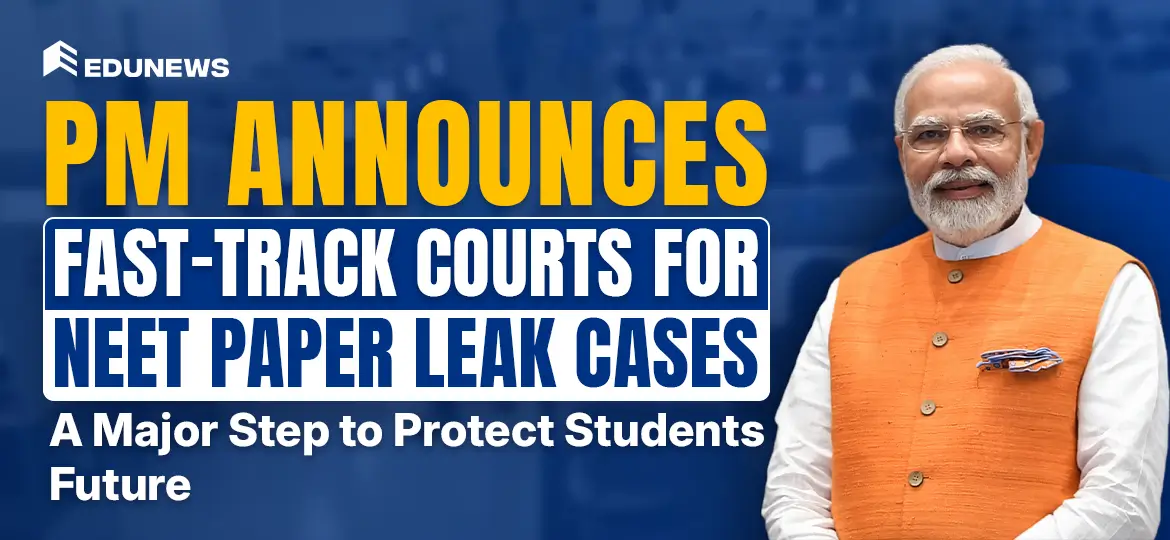
Amid the controversy over the NEET UG 2026 paper leak and the CJP (Cockroach Janata Party), with millions of students’ massive protest at Delhi’s Jantar Mantar, a significant move is being taken by the Government of India, and Prime Minister Narendra Modi announced on his ‘X‘ handle that “a fast-track court will be established to handle NEET paper leak cases”. The Union Cabinet has approved a bill proposing stricter punishments for examination paper leaks, with the legislation likely to be introduced in Parliament next week.
PM Modi’s Statement on the Paper Leak Crisis
“Nothing is more important than the welfare and future of the youth”, as stated by PM Narendra Modi on July 23, 2026.
This initiative seeks to ensure swift justice against those involved in exam-related fraud and strengthen confidence in India’s education and recruitment system. The prime minister stated that the government has directed the concerned authorities and officials to take all necessary steps in this regard, adding that this continues a series of measures aimed at safeguarding the interests of students.
He also stated that those who try to harm the future of our youth will not be spared. However, the Leader of Opposition (LoP) Rahul Gandhi quickly hit back at Prime Minister Modi’s announcement, holding him directly responsible for the crisis and saying
“you are the one who has harmed the future of our youth the most”, as per Times of India.
After stepping up his attack on Modi, the Lok Sabha leader of the opposition alleged:
“You allowed and encouraged the total capture and destruction of our education system and protected every person responsible for it”.
Jantar Mantar protest: Day-by-day highlights (July 19–24, 2026)
The above announcement comes after five days of escalating protest at Jantar Mantar, summarised below.
| Date | Key developments |
|---|---|
| 19 July (Sun) | Hunger strike entered its third week. Activist Sonam Wangchuk was hospitalised due to health concerns, while other fasting protesters continued at Jantar Mantar. Organisers confirmed the planned “Sansad Chalo” march would go ahead on 20 July. |
| 20 July (Mon) | Thousands gathered at Jantar Mantar before dawn for the Sansad Chalo march toward Parliament. Delhi Police stopped marchers using barricades, tear gas, and batons after protesters attempted to move toward Parliament. Several people were injured and detained. |
| 21 July (Tue) | Protesters returned to Jantar Mantar and continued the sit-in despite the police action. Volunteers organised food distribution, first aid, and accommodation for demonstrators arriving from different states. Support for the movement expanded online and among student groups. |
| 22 July (Wed) | Security around central Delhi was tightened. Several Delhi Metro stations near the protest site were temporarily closed, and barricades were strengthened to prevent another march toward Parliament. |
| 23 July (Thu) | Volunteers established medical camps at Jantar Mantar to treat protesters. The central government attempted to initiate talks, but discussions stalled over disagreement on the meeting venue. Protest leaders announced that demonstrations would continue. |
| 24 July (Fri – Today) | A nationwide solidarity protest was called under the slogan “Every District. One Day. One Demand.” Delhi imposed heavy security measures, closing 17 Metro stations and restricting mobile internet in parts of central Delhi. Prime Minister Narendra Modi announced measures such as fast-track courts and stricter action against exam-paper leaks, but protesters said they would continue until their main demands are met. |
What is the Fast Track Court & How Does It Work in India?
A Fast Track Court in India is a dedicated judicial mechanism specifically designed to expedite legal proceedings, reduce massive case backlogs, and deliver swift justice for sensitive or high-priority offences such as crimes against women, POCSO cases, and major public interest matters.
The FTC is not a separate court; it is a lower court designed by the state government in consultation with the respective high courts to try specific types of cases such as rape cases, heinous crimes, and public examination paper leaks. FTCs operate with a strict mandate to prioritize designed categories of these offences and aim to examine witnesses consecutively within a compressed timeline.
Delhi High Court Sets Up Special Fast Track Court
The biggest challenge in India is conducting competitive exams fairly and transparently. Due to paper leaks in India, millions of honest students suffer while criminals profit. After Modi’s announcement on NEET Paper leaks, the Delhi High Court released a notification on Thursday, July 23, 2026, stating that the government would establish fast-track courts to ensure expeditious trials in paper leak cases.
The court of judicial officer Anu Grover Baliga has been notified as a “Specially Designed Fast Track Court” to try offences under the Public Examinations (Prevention of Unfair Means) Act, 2024, as stated by DHC. Earlier, Judge Baliga was serving as the judge in charge of the Mediation Centre in the Central District at Tis Hazari Courts. The special court will function from the “Rouse Avenue Court Complex in Delhi”.
Why the Fast Track Court for NEET Paper Leaks?
As per the Indian Express report, around 45 major exam papers were leaked between 2002 and 2025, with each involving at least one lakh candidates. Every year, lakhs of students spend months or even years preparing for government examinations. When examination papers are leaked, these students are affected more. The government decision to create fast-track courts aims to;
- Deliver speedy justice in paper leak cases.
- Ensure strict punishment for offenders.
- Prevent delays in legal proceedings.
- Restore students’ confidence in the examination system.
- Deter organised examination fraud networks
Government’s Crackdown on Examination Fraud
A government crackdown on examination fraud refers to the measures taken by authorities to prevent cheating, paper leaks, impersonation, and other forms of malpractice in the examinations. The common steps in such a crackdown include;
- Enacting stricter laws with heavier penalties for offenders.
- Using advanced technology such as biometric verification, CCTV surveillance, AI-based monitoring, and encrypted question paper distribution.
- Conducting raids and investigations against cheating gangs and paper leak networks.
- Cancelling compromised examinations and holding re-examinations when necessary.
- Debarring candidates and taking legal action against officials or institutions involved in malpractice.
- Strengthening security during the printing, transportation, and storage of examination papers.
Sonam Wangchuk Ends Hunger Strike
Social activist and engineer Sonam Wangchuk ended his 26-day hunger strike after receiving written assurances from the Central Government on Friday, July 23, 2026. His fast had highlighted concerns about accountability in the examination system and support for students affected by the alleged NEET paper leak controversy. The government assured that peaceful protesters would not face punitive action and that issues related to examination reforms and accountability would be discussed further.
“Just now in the presence of Union Ministers Sh. JP Nadda, Dr Jitendra Singh and the senior leaders of the Apex Body of Leh Ladakh, I finally broke my fast after 26 days. Earlier, 65 members of parliament from different political parties had visited or signed letters urging me to break the fast. This was done after long negotiations on various conditions and in view of possible violence in the country. The government also gave assurance that families of suicide victims in the recent NEET examination paper leak will be given adequate compensation and that there will be no cases registered against the peacefully protesting students and youths.” Sonam Wangchuk posted on their X handle.
Conclusion
The recent announcement by PM Narendra Modi to establish fast-track courts for paper leak cases marks an important step towards protecting the future of India’s youth. Swift legal action against examination fraud can strengthen public trust, safeguard honest candidates, and reinforce the credibility of competitive examinations.
This initiative for millions of students preparing for government services and higher education signals a stronger commitment to fairness, transparency, and merit-based opportunities.
Frequently Asked Questions
Fast-track courts are special courts intended to expedite the hearing and disposal of cases related to examination paper leaks and associated fraud.
They help ensure quicker justice, discourage organised exam fraud, and protect the interests of genuine students.
Students appearing for competitive exams, educational institutions, recruitment agencies, and the overall examination system.
While no single measure can eliminate paper leaks, quicker trials and stricter enforcement can increase deterrence when combined with stronger preventive measures.
Major entrance and recruitment examinations such as UPSC, SSC, NEET, JEE, CUET, banking, railway, police, and state-level competitive exams could benefit from improved legal safeguards.
