

NEET (National Eligibility cum Entrance Test) is not merely an examination but the very point on which the backs of millions of aspirants are leaning. Therefore, to tackle this heated competition, you should complement your effort with a mind map and Best Time Table for NEET Preparation 2027.
There is a common question among NEET aspirants regarding NEET preparation: “What is the best schedule to prepare for NEET?” In this post, we shall provide you with the best timetable to prepare for NEET, whether you are still in school, out of school, a dropper, or want a schedule for the holidays.
Since the NEET 2027 dates haven’t been released yet, let’s take full advantage of this time to clear the syllabus along with a bunch of mock tests to solve NEET question banks, based on previous NEET UG Exams. For that purpose, the best timetable for aspirants for NEET UG 2027 will serve you to prioritise the syllabus, achieve your targets, clear your mind, and manage your time appropriately.
Why is a Timetable Important for NEET Aspirants?
Creating a timetable for NEET UG 2027 provides effective direction to the aspirants who are aiming for the upcoming NEET 2027 examination. The NEET syllabus is so extensive that it requires a well-structured timetable when preparing for India’s most competitive medical entrance test. Here’s a sample daily timetable to guide your preparation.
| Time | Activity |
|---|---|
| 6:30 AM-8 AM | Wake up, breakfast, morning routine |
| 8-11 AM | Solve MCQs, review new concepts, and focus on weak areas |
| 11-12 PM | Break – engage in relaxing activities |
| 12-2 PM | Homework, assignments, practice exercises |
| 2-3 PM | Lunch, nap if needed |
| 3-5 PM | Self-study, explore interesting subjects |
| 5-6 PM | Tea/Coffee break, evening walk, leisure activities |
| 6-9 PM | Attend online coaching sessions |
| 9-10 PM | Dinner, spend time with family, or just relax |
| 10-11 PM | Review and make notes of the day’s study material |
| 11 PM | Sleep |
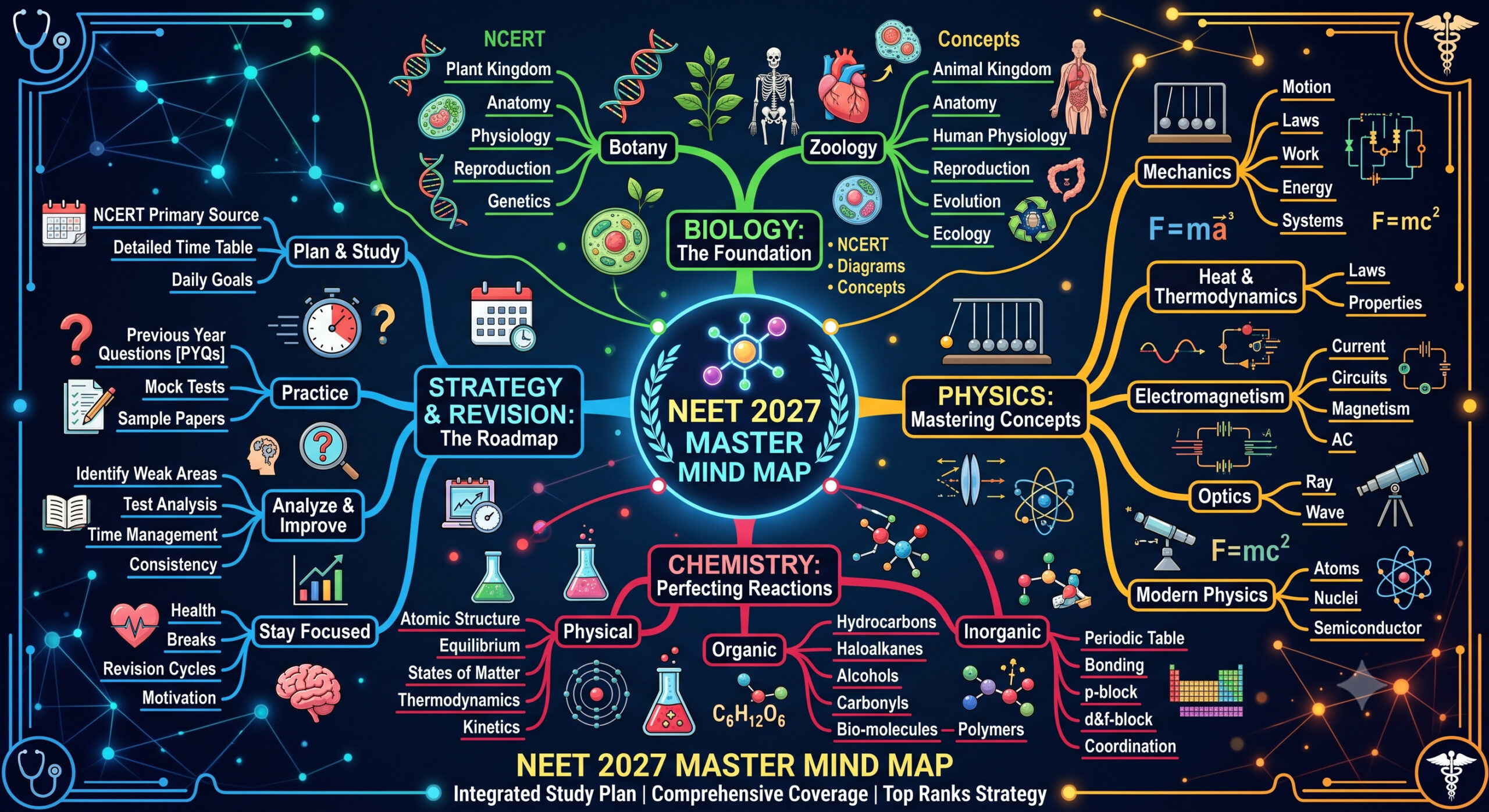
NEET 2027 Master Mind Map
Here’s a NEET 2027 Master Mind Map that you can use as your preparation blueprint. It is based on the NEET syllabus (Class 11 & 12 NCERT) and common preparation strategies recommended for NEET aspirants.
Monthly Preparation Plan for NEET 2027
Instead of studying randomly, follow this monthly plan, the backbone of a structured NEET 2027 preparation strategy.
| Phase | Duration | Primary Goal | Physics | Chemistry | Biology | Practice & Tests |
|---|---|---|---|---|---|---|
| Phase 1: Foundation | July – September 2026 | Build strong concepts and complete the Class 11 syllabus | Units & Measurements, Kinematics, Laws of Motion, Work-Energy, Thermodynamics | Mole Concept, Atomic Structure, Chemical Bonding, Thermodynamics, Equilibrium | Cell, Biomolecules, Plant Physiology, Human Physiology | Daily MCQs (80–100), Chapter PYQs, Weekly Test |
| Phase 2: Class 12 Syllabus | October – December 2026 | Complete Class 12 syllabus | Electrostatics, Current Electricity, Magnetism, Optics, Modern Physics | Electrochemistry, Chemical Kinetics, Organic Chemistry, Coordination Compounds | Genetics, Evolution, Biotechnology, Ecology, Reproduction | Daily MCQs (120+), Weekly Subject Test, Monthly Full Test |
| Phase 3: First Revision | January 2027 | Revise the entire syllabus chapter-wise | Formula revision + PYQs | NCERT revision + Organic reactions | NCERT line-by-line revision | 2 Full-Length Tests/week + Error Analysis |
| Phase 4: Intensive Practice | February 2027 | Strengthen weak topics | Mixed-topic questions | Mixed-topic questions | Mixed-topic questions | 3–4 Full-Length Tests/week, Analyse mistakes |
| Phase 5: Final Revision | March 2027 | Rapid revision of the complete syllabus | High-weightage chapters, formulas | NCERT, named reactions, inorganic revision | Complete NCERT revision multiple times | Alternate-day Mock Tests, PYQ Revision |
| Phase 6: Last Month | April 2027 | Exam simulation | Formula notebook | Short notes | NCERT diagrams & tables | Daily Mock Tests (or alternate days), Time Management, OMR Practice |
Timetable for School-Going Students Preparing for NEET
If you’re attending regular school, here is a self-study plan for NEET preparation-
| Time | Activity |
|---|---|
| 5:30-6:30 AM | Solve MCQs |
| 6:30–7:00 AM | Get ready for school (adjustable as per your school timings) |
| 7:30 AM–1:30 PM | Study from coaching modules, homework, and assignments |
| 2-2:30 PM | Lunch, take a short nap if required |
| 2:30-5:30 PM | Study from coaching modules, homework, and assignments |
| 6-9 PM | Online Coaching |
| 9-10 PM | Dinner & entertainment |
| 10-11 PM | Make notes, revise stuff |
| 11 PM | Sleep |
NEET 2027 Preparation Timetable for Droppers
Whether you’re taking another attempt or a drop year to prepare for NEET 2027, here is a timetable for you-
| Time | Activity |
|---|---|
| 6.30-8 AM | Wake up, breakfast, morning routine |
| 8–10 AM | Weak areas, new concepts, and MCQs |
| 10–11 AM | Break |
| 11-1 PM | Important topics |
| 1-2 PM | Lunch |
| 2-3 PM | Take a short nap if required |
| 3-5 PM | Online/Offline coaching (if opted) |
| 5-6 PM | Relax |
| 6-8 PM | Make notes, study subjects you find interesting |
| 8-9 PM | Dinner and family time |
| 9-10 PM | Revision |
| 10 PM | Sleep |
NEET 2027 Study Plan for Different Students
The following is a complete NEET 2027 study plan that students can use, whether they are in Class 11, Class 12, droppers, school-going, non-schooling, self-study, or working students. You can follow the NEET 2027 preparation plan below.
| Student Type | Available Time | Main Focus | Daily Study Hours | Mock Tests | Biology Priority | Chemistry Priority | Physics Priority |
| Class 11 Student (2025–26) | ~2 years | Build strong basics, avoid backlogs | 5–7 hrs (plus school/coaching) | Weekly chapter tests | ⭐⭐⭐⭐⭐ | ⭐⭐⭐⭐ | ⭐⭐⭐⭐ |
| Class 12 Student (2026–27) | ~1 year | Complete Class 12 while revising Class 11 | 7–9 hrs (plus school/coaching) | Weekly + monthly full tests | ⭐⭐⭐⭐⭐ | ⭐⭐⭐⭐ | ⭐⭐⭐⭐ |
| Dropper (Full-Time) | ~1 year | Full syllabus mastery and revision | 9–12 hrs | 2–3 full mocks/week (later phase) | ⭐⭐⭐⭐⭐ | ⭐⭐⭐⭐⭐ | ⭐⭐⭐⭐⭐ |
| School + Coaching Student | Limited self-study time | Balance academics and NEET | 4–6 hrs self-study | Weekly coaching tests | ⭐⭐⭐⭐⭐ | ⭐⭐⭐⭐ | ⭐⭐⭐⭐ |
| Self-Study Student | Flexible | Concept building + discipline | 8–10 hrs | Weekly full/chapter tests | ⭐⭐⭐⭐⭐ | ⭐⭐⭐⭐ | ⭐⭐⭐⭐ |
| Working Student/Part-Time Aspirant | Limited | Consistent progress | 3–5 hrs | Weekend mock tests | ⭐⭐⭐⭐⭐ | ⭐⭐⭐ | ⭐⭐⭐ |
Conclusion
A well-planned NEET preparation timetable is the key to cracking this highly competitive exam. It ensures equal coverage of all three subjects, Physics, Chemistry, and Biology, with emphasis on the toughest topics.
Taking time for NCERT books, mock tests, and revisions every day increases confidence and clarity. Proper breaks and stress management during the day help maintain focus for a longer time. It helps in formulating realistic goals and makes the journey toward NEET success more manageable and productive.
Frequently Asked Questions
For a proper NEET UG 2027 timetable, experts recommend taking around 10-13 hours a day, including breaks and revision time.
The optimum study duration for preparation for NEET is 5–7 for Class 11, 7–9 for Class 12, and 9–12 for droppers.
An effective study timetable for NEET aspirants should involve consistency with periodic balance in subjects, maintaining regular revision, and also practising mock tests depending on their own learning style and time disposition.
An effective study timetable for NEET demands consistency, balance across subjects, periodic revision, and inclusion of mock tests, while also keeping the upkeep of personal learning styles and daily schedules.
To keep you motivated for the ultimate NEET preparation, set achievable goals, frame the best time table for NEET 2027, practice regularly with previous year papers, focus on weak areas, keep an interest in your subjects, and take breaks for self-care.
– NCERT textbooks: These books are highly recommended as they cover most of the NEET syllabus.
– MTG Objective NCERT at your fingertips Chemistry: This book is based on the NCERT latest pattern for the 2027 exam.
– Truemans Biology Vol. 1 & 2 Objective Biology: This book is widely referred to for the Biology section.
– H C Verma for Physics: This book is considered one of the best books for NEET preparation.
– Modern ABC of Chemistry for Class 11th & 12th (Vol. 1 & 2): This book is considered one of the best books for NEET preparation.
– PW Store books: These books are considered to be affordable and offer high-quality content.
– NEET PCB Tatva Practice Books: These books are available for classes 11, 12, and droppers.
– MTG Learning Media: This website offers free PDFs of the NEET syllabus, sample papers, previous year papers, and NEET biology questions.
In a good timetable, students should complete a good part of their NEET UG syllabus before attempting mock tests under timed conditions regularly. Consider your results thoroughly after each test to recognise your weak areas, practice questions from NEET past years’ papers, and become familiar with the exam format and kind of questions.
The NEET timetable should include starting early, as it’s never too early to begin revising, creating a revision timetable, breaking down information, using active revision techniques, and taking regular breaks to stay healthy and keep your mind fresh.
According to the latest NTA NEET Exam Pattern, There will be a total of 180 questions in the NEET-UG 2027 across Physics (45 questions), chemistry (45 questions) and biology (90 questions).
– Every question carries 4 marks.
– Selecting the right answer or the most appropriate: +4 marks.
– The wrong option is marked: -1 mark.
– No answer to a question: 0 marks.
– When more than one option is correct, +4 marks are awarded to those who select any of the correct options.
– If all the options are correct, then all who attempt the question receive +4 marks.
– If none of the above is correct, it is a wrong question or is dropped, then +4 marks to each candidate, irrespective of whether they attempted the question.
Candidates can attempt NEET in 13 languages such as English, Hindi, Assamese, Bengali, Gujarati, Malayalam, Kannada, Marathi, Odia, Tamil, Telugu, Urdu, and Punjabi.
