
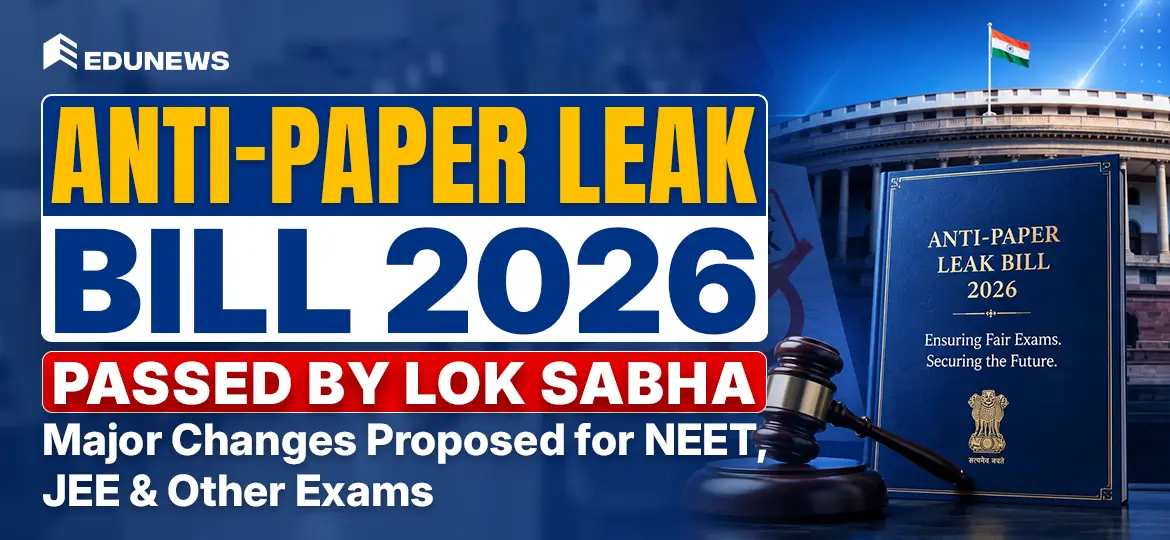
In a significant move to strengthen the integrity of India’s public examination system, the Lok Sabha has passed the Public Examinations (Prevention of Unfair Means) Amendment Bill, 2026, popularly known as the Anti-Paper Leak Bill 2026. The legislation, introduced by Union Minister Dr Jitendra Singh on 27 July 2026, was approved by the Lower House through a voice vote on 29 July 2026 and now awaits consideration in the Rajya Sabha before it can receive Presidential assent.
“The amendment seeks to strengthen the examination system by ensuring fairness, transparency and credibility in public examinations.” – Union Minister Jitendra Singh (Minister of State, Personnel)
The amendment seeks to reinforce the Public Examinations (Prevention of Unfair Means) Act, 2024, India’s first comprehensive central legislation aimed at preventing paper leaks and organised examination fraud. The proposed law introduces substantially higher penalties for offenders, tighter accountability for examination agencies and service providers, dedicated Special Fast-Track Courts, and mandatory timelines for investigation and trial of offences.
The government’s decision comes against the backdrop of the NEET (UG) 2026 paper leak controversy, which triggered widespread protests by students and parents across the country. The controversy led to the cancellation of the examination, a subsequent re-examination, and a Central Bureau of Investigation (CBI) probe into the alleged paper leak.
“The government is committed to ensuring a fair and transparent examination system for the youth of the country.” Stated by Union Home Minister Amit Shah
The incident also prompted the government to establish a national examination reform task force under Infosys co-founder Nandan Nilekani to recommend structural reforms for improving the security, transparency and credibility of India’s public examination system.
Tougher Punishment for Examination Fraud
One of the most significant features of the proposed amendment is the sharp increase in punishment for individuals and organised groups involved in examination malpractice.
Individual Candidates:
- Imprisonment: 5 to 10 years (up from 3–5 years under the 2024 Act)
- Fine: Up to ₹50 lakh (up from ₹10 lakh)
Organised Paper Leak Syndicates:
- Imprisonment: 7 to 10 years
- Fine: Up to ₹10 crore
Private Service Providers (Exam Conducting Agencies):
- Corporate Fine: Up to ₹5 crore for negligence or complicity
- Debarment: Banned from public examinations for up to 8 years (up from 4 years)
- Management Liability: Directors and senior executives face direct criminal prosecution, jail time, and heavy fines for operational lapses
“The focus should be on preventing leaks and fixing accountability rather than only changing the law.” Stated by Mallikarjun Kharge, Leader of the Opposition in the Rajya Sabha
Special Courts and Time-Bound Investigation
The amendment proposes the creation of Special Task Forces (STFs) dedicated to investigating organised examination fraud. It also requires every State and Union Territory to establish Special Fast-Track Courts exclusively for offences under the Public Examinations Act.
According to the proposed framework, investigations into paper leak cases must be completed within two months, while trials are expected to conclude within three months of filing the chargesheet. The legislation also seeks to strengthen digital investigations, allowing agencies to make greater use of electronic evidence while improving coordination among Central and State Governments, examination authorities and law-enforcement agencies.
“The amendment provides for fast-tracked investigation, speedy trial through Special Fast Track Courts and stricter penal provisions to effectively deter unfair means and organised malpractices in public examinations.” Stated by Dr Jitendra Singh, Union Minister of State
Impact on NEET, JEE and Other Competitive Examinations
The Public Examinations (Prevention of Unfair Means) Act covers examinations conducted by several major Central Government agencies, including the Union Public Service Commission (UPSC), Staff Selection Commission (SSC), Railway Recruitment Boards (RRBs), Institute of Banking Personnel Selection (IBPS) and the National Testing Agency (NTA), which conducts NEET, JEE Main, CUET and other national-level entrance examinations.
If enacted, the amendment will directly strengthen the legal framework governing these examinations. The government maintains that the tougher provisions are intended to ensure that admissions and recruitment are determined solely by merit rather than access to leaked question papers or organised cheating networks.
“The education system should provide equal opportunity, not become a system where students are eliminated because of failures in examination management” – By Deepender Singh Hooda, Congress MP
Importantly, the proposed amendment does not affect the ongoing counselling process, seat allotment schedule or Medical Counselling Committee (MCC) counselling dates for the current admission cycle.
Current Status of the Bill
As of 30 July 2026, the Public Examinations (Prevention of Unfair Means) Amendment Bill, 2026 has been passed by the Lok Sabha but has not yet become law. The Bill must still be approved by the Rajya Sabha and subsequently receive Presidential assent before its provisions come into force. Until then, the Public Examinations (Prevention of Unfair Means) Act, 2024 continues to remain the applicable law governing offences related to public examinations in India.
Official Sources
- Press Information Bureau (PIB): Public Examinations (Prevention of Unfair Means) Amendment Bill, 2026 – https://pib.gov.in
- PRS Legislative Research – Bill Summary and Legislative Tracker – https://prsindia.org
- Lok Sabha – Bills and Legislative Business – https://sansad.in/ls/business/agenda
- Ministry of Personnel, Public Grievances and Pensions – https://dopt.gov.in
- National Testing Agency (NTA) – https://nta.ac.in
